
Which Countries Have Right to Repair Laws?
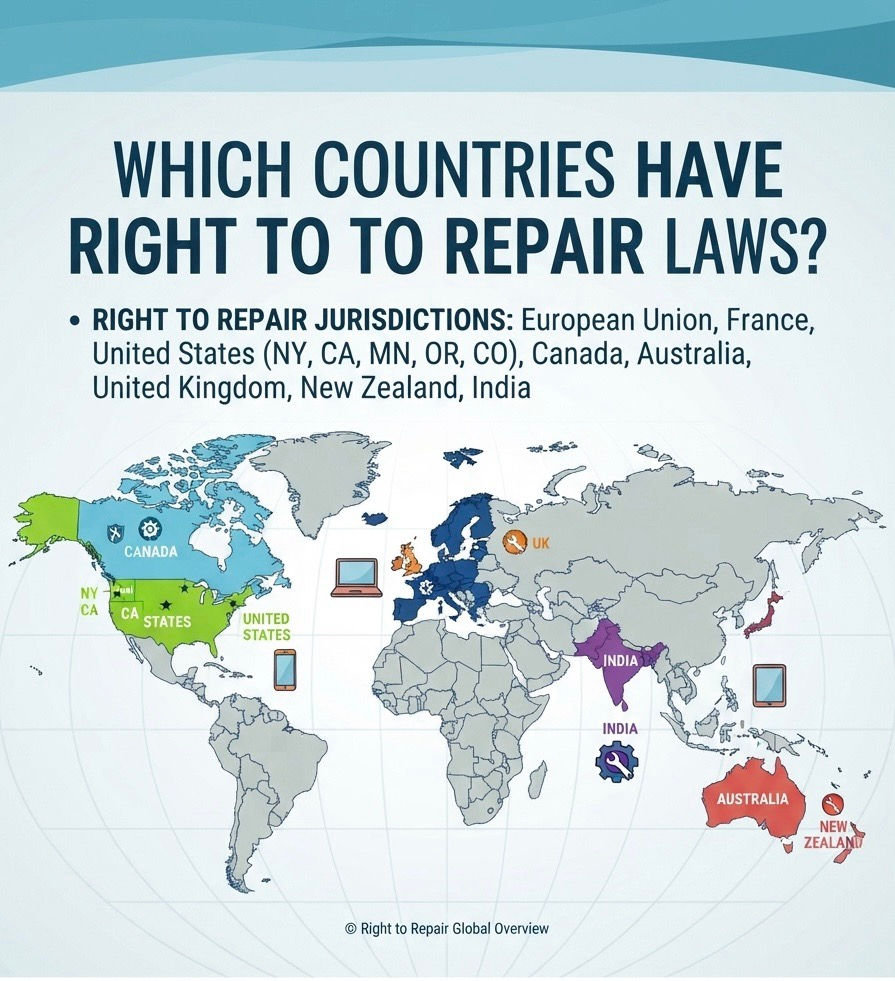
The Right to Repair movement has gained momentum worldwide as governments respond to growing concerns about electronic waste, consumer rights, product longevity, and market competition. While the concept is often discussed as a single global movement, Right to Repair laws differ significantly from one country to another.
Some jurisdictions have enacted comprehensive legislation requiring manufacturers to provide repair information and spare parts, while others have adopted narrower regulations that apply only to specific products or industries.
This article provides an overview of countries that have enacted Right to Repair laws or legally enforceable repair requirements as of 2026.
What Is a Right to Repair Law?
A Right to Repair law is legislation that gives consumers and independent repair providers greater access to the parts, tools, software, documentation, or diagnostic information needed to repair products.
Although the details vary by jurisdiction, these laws generally aim to:
Extend the usable life of products
Increase consumer choice in repair services
Reduce electronic waste
Promote competition within the repair market
Lower repair costs over time
Not every country uses the phrase "Right to Repair" in its legislation. Some instead regulate repairability through consumer protection, environmental policy, product design standards, or competition law.
Countries With Right to Repair Laws
🇪🇺 European Union
The European Union has become one of the world's leading regulators of repairability through a combination of ecodesign regulations and consumer protection legislation.
Key measures include:
Mandatory availability of spare parts for certain household appliances
Repair-friendly product design requirements
Repair information available to qualified repair professionals
Consumer rights encouraging repair over replacement in appropriate situations
A broader Right to Repair framework adopted in 2024 and being implemented across Member States
Rather than creating one standalone repair law, the EU uses several complementary regulations that collectively strengthen repair rights across participating countries.
🇫🇷 France
France introduced one of the first nationwide repairability policies through its Repairability Index.
Certain products must display a repairability score at the point of sale, helping consumers compare how easily products can be repaired before purchasing.
The index evaluates factors such as:
Availability of spare parts
Ease of disassembly
Access to repair documentation
Product design
Cost and availability of replacement components
France continues expanding repair-related requirements through broader environmental legislation.
🇺🇸 United States
The United States does not have a comprehensive federal Right to Repair law that applies to all products. Instead, individual states have enacted their own legislation addressing specific products and industries.
As of 2026, states including New York, California, Minnesota, Oregon, and Colorado have passed Right to Repair laws covering categories such as:
Consumer electronics
Agricultural equipment
Powered wheelchairs
Medical equipment
Motor vehicles
Because these laws are enacted at the state level, their scope and requirements vary by jurisdiction. Differences may include:
The types of products covered
Documentation and repair manual requirements
Access to diagnostic software and tools
Rights granted to independent repair providers
Manufacturer obligations to provide parts, tools, and repair information
In addition to state legislation, several federal agencies have adopted policies that support greater competition in the repair market by encouraging manufacturers to reduce unnecessary repair restrictions. However, as of 2026, the United States has not enacted a single nationwide Right to Repair law, although federal legislation continues to be considered.
🇨🇦 Canada
Canada has strengthened repair rights through amendments to federal copyright legislation and continues to evaluate broader repair legislation.
Recent reforms help reduce legal barriers that previously limited repairs involving technological protection measures.
Several provinces have also introduced or studied Right to Repair legislation, with discussions continuing on expanding repair access across additional product categories.
🇦🇺 Australia
Australia has introduced repair-related reforms in several industries rather than adopting one comprehensive Right to Repair statute.
Government reviews have recommended expanding repair opportunities, particularly for:
Agricultural machinery
Motor vehicles
Consumer electronics
The automotive industry already operates under legislation requiring manufacturers to share repair information with independent repair businesses.
Additional reforms continue to be evaluated.
🇬🇧 United Kingdom
Following its departure from the European Union, the United Kingdom implemented repair requirements through Ecodesign regulations.
These rules require manufacturers of certain household appliances to make spare parts available for several years after products are sold.
The regulations currently apply primarily to:
Washing machines
Dishwashers
Refrigeration equipment
Televisions
Other selected household appliances
Consumer groups continue advocating for broader repair rights covering smartphones, laptops, and additional electronic devices.
🇳🇿 New Zealand
New Zealand has been actively considering national Right to Repair legislation.
While comprehensive legislation has not yet been fully implemented, parliamentary proposals and public consultations have focused on improving access to repair information, spare parts, and manufacturer support.
The issue remains under active legislative discussion.
🇮🇳 India
India has taken significant steps toward establishing a national Right to Repair framework.
Government initiatives have focused on creating a repair information portal covering sectors such as:
Consumer electronics
Mobile phones
Agricultural equipment
Automobiles
The initiative seeks to improve consumer access to repair resources while encouraging a stronger independent repair industry.
Implementation continues as regulations develop.
Countries Considering Right to Repair Legislation
Many additional countries are exploring repair reforms, including:
Brazil
South Africa
Norway
Switzerland
Japan
South Korea
Some proposals focus on consumer electronics, while others target agriculture, automotive repair, or environmental sustainability.
Because legislative proposals frequently change, countries may move from consultation to enacted legislation over time.
Why Right to Repair Laws Differ
No two Right to Repair laws are exactly alike.
Governments often balance several competing interests, including:
Consumer protection
Intellectual property rights
Product safety
Cybersecurity
Environmental sustainability
Market competition
As a result, one country's law may require manufacturers to provide spare parts but not software tools, while another may require diagnostic access without mandating public repair manuals.
Understanding these differences is essential when comparing repair laws across jurisdictions.
The global Right to Repair movement continues to evolve. More governments are evaluating policies that encourage repair as a way to reduce waste, support consumers, and promote competition.
While the pace of reform varies, the overall trend is toward expanding repair opportunities across a wider range of products.
Consumers, manufacturers, repair businesses, and policymakers will likely continue shaping how repair rights develop in the years ahead.
Conclusion
Right to Repair legislation is no longer limited to a handful of jurisdictions. The European Union, France, the United States, Canada, Australia, the United Kingdom, India, and several other countries have enacted or are developing legal frameworks that expand repair access in different ways.
Although these laws vary in scope and requirements, they reflect a growing international recognition that repair plays an important role in consumer choice, product longevity, environmental sustainability, and competitive markets.
As new legislation continues to emerge, understanding the legal landscape remains essential for consumers, manufacturers, independent repair providers, and policymakers alike.
Comments